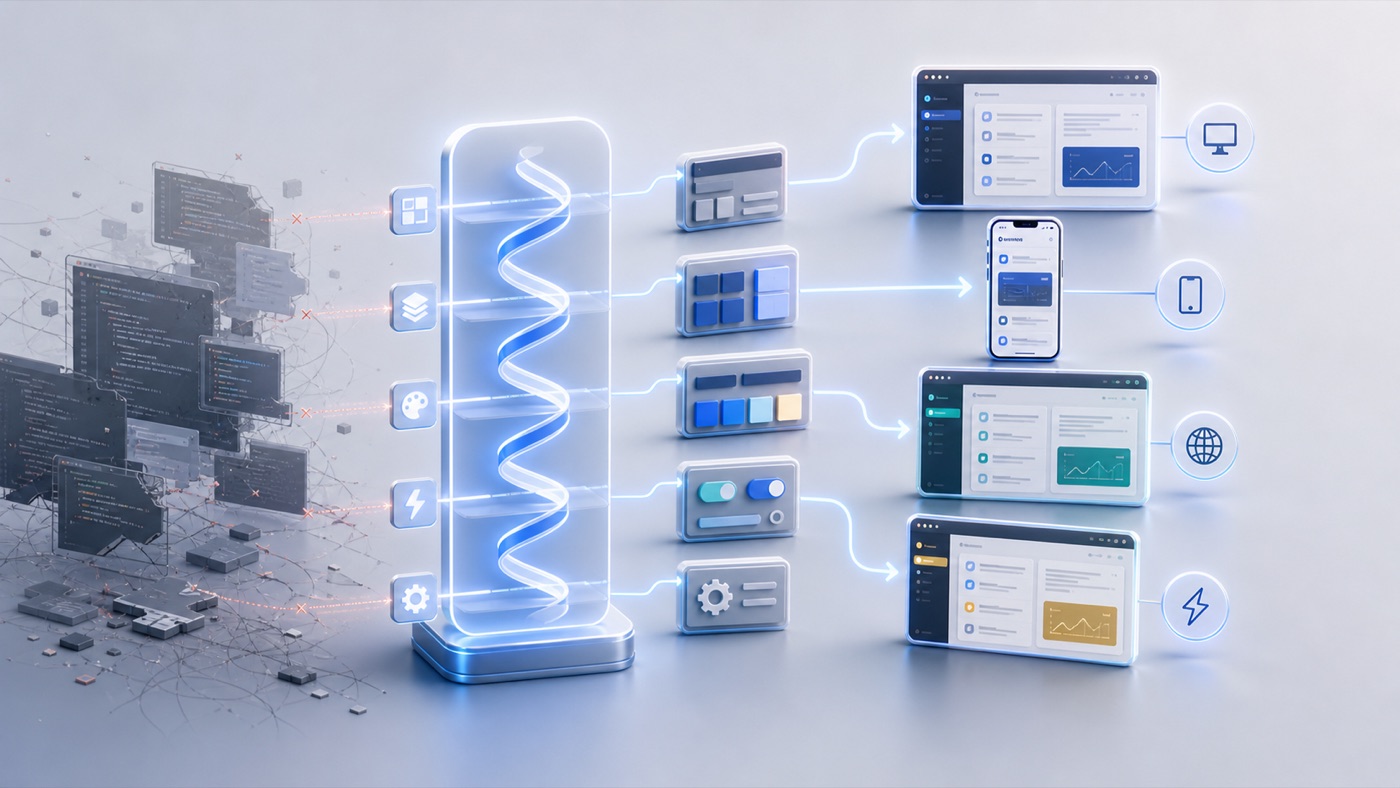
Old business software rarely becomes hard to change because of one bad decision.
It becomes hard to change because intent disappears.
Years pass. Screens evolve. Exceptions are added. A customer needs something urgent. A field moves. A rule changes. A mobile version is requested. A new language is added. A workflow gets patched. The original reason for the page slowly disappears behind layers of code.
At some point, the team no longer knows what the page was supposed to be.
They only know what the code currently does.
That is a dangerous place to build with AI.
Because AI can patch old code faster.
But if the product intent is gone, faster patching only accelerates confusion.
The future of AI-generated business software is not patching old code faster. It is preserving product intent so the experience can evolve with context.
That is the idea behind Page Genome.
A page is more than its current code
A business page is not just a file.
It is a product decision.
It has a target user. It has a workflow. It has permissions. It has layout behavior. It has device expectations. It may have language variants. It may have different interaction patterns for desktop and mobile. It may need to support infinite scroll in one context and traditional pagination in another.
When all of that intent is buried inside implementation details, the system becomes fragile.
The team can still change the code.
But it becomes harder to know whether the change respects the original product goal.
That is how enterprise software turns into archaeology.
Every change begins with a question:
why is this screen like this?
If no one knows, the safest answer is often another small patch.
And another.
And another.
Patching is not the same as evolving
Patching has a place.
Production systems need fixes.
But endless patching is not evolution.
Patching usually asks:
what is the smallest code change that makes this issue go away?
Evolution asks something different:
what should this experience become, and what intent should it preserve?
That distinction matters for business software.
If a product editor needs a mobile version, the answer should not be to squeeze the desktop page until it barely fits. If a workflow needs a different behavior for a specific customer segment, the answer should not be to hide more conditionals in old code. If a page needs localization, the answer should not be to scatter translations as an afterthought.
The better approach is to preserve the page intent and let the system create coherent variations from that intent.
That is what Page Genome is meant to organize.
What Page Genome means
Page Genome is the Collab Aura opinion for organizing pages by experience category.
Publicly, the important idea is not an internal folder code or naming convention.
The important idea is this:
a page should carry enough structured intent to evolve across device, layout, behavior, and language without losing its product meaning.
That can include questions like:
- what kind of experience is this page?
- is it designed for desktop, mobile, or another category?
- what workflow does it serve?
- what behavior pattern does it use?
- what parts of the experience can vary?
- what should remain consistent?
- which language or publishing variation is needed?
- which component contracts does it depend on?
The goal is not to make page creation heavier.
The goal is to prevent future change from becoming blind maintenance.
Why this matters more with AI
AI makes this problem more urgent.
When humans patch old code slowly, the damage accumulates slowly.
When AI patches old code quickly, the damage can accumulate quickly.
The risk is not that AI writes code.
The risk is that AI writes code without understanding the product shape it is supposed to preserve.
If the only thing an agent sees is an old implementation, it may optimize for local correctness. It may make the change requested in the prompt. It may even pass tests.
But it may still weaken the product architecture.
A page genome gives AI a better target.
Instead of asking the agent to modify a pile of code, the system can preserve a higher-level understanding of the page: its purpose, its category, its behavior, its device assumptions, and its variation path.
That is a better foundation for AI-assisted maintenance.
Variations should be intentional
Modern business software does not live in one fixed shape.
The same product capability may need multiple expressions:
- a desktop version for dense operational work;
- a mobile version for quick action;
- a language variant for another market;
- a behavior variant for a customer preference;
- a component variation for a specific design system;
- a publishing variation for a different deployment target.
Without structure, those variations become forks, patches, and conditionals.
With preserved intent, they can become part of the product model.
This is especially important for Collab.codes because the platform is designed around generated and AI-maintained applications. If every variation becomes a one-off patch, the system gets harder to evolve. If variations are organized as part of the page’s genome, the application can change without losing its conceptual center.
The page should remember why it exists
This is the simplest way to explain it:
the page should remember why it exists.
Not in a philosophical way.
In a practical product architecture way.
The page should know what type of experience it represents. It should keep a connection to its layout behavior. It should make room for localization. It should support future categories like mobile, iOS, or Android without forcing the company to rediscover the same intent from old code.
That memory becomes valuable over time.
It helps humans understand the product.
It helps AI agents make better changes.
It helps reviewers evaluate whether a variation still respects the original workflow.
It helps the system evolve by creating new specified experiences instead of endlessly editing the same old implementation.
Why this fits Collab.codes
Collab.codes is built around the idea that business software should be created, executed, maintained, and evolved with AI.
That requires more than code generation.
It requires product memory.
Creation needs to capture intent.
Runtime needs to execute the application.
Studio needs to help humans and AI propose changes in context.
Build and publishing need to prepare the right variant for the right target.
Page Genome connects those ideas at the page level.
It gives each screen a better chance to remain understandable as the application grows.
The future is less archaeological
A lot of enterprise software maintenance feels like archaeology.
People dig through old code to infer decisions that should have remained explicit.
AI can help with that.
But the better future is to need less archaeology in the first place.
Preserve the intent.
Generate from the intent.
Create variations from the intent.
Review changes against the intent.
That is the promise of Page Genome.
It does not remove engineering discipline.
It gives engineering, product, and AI a shared memory of what the page is trying to be.
That is how software evolves without becoming a pile of patches.
— Wagner, CEO at Collab.codes