There is a question every company should be asking in 2026:
if AI can already help us build software, why are we still choosing between heavy ERPs and generic SaaS?
For years, that was the default tradeoff.
On one side, the traditional ERP: powerful, expensive, slow to implement, hard to adapt, and often far away from how the business actually works.
On the other side, modern SaaS: fast to start, polished, accessible, but often rigid. It solves the average problem well. The problem is that no serious company wants to become only the average of its market.
AI changes that equation.
But not in the simplistic way.
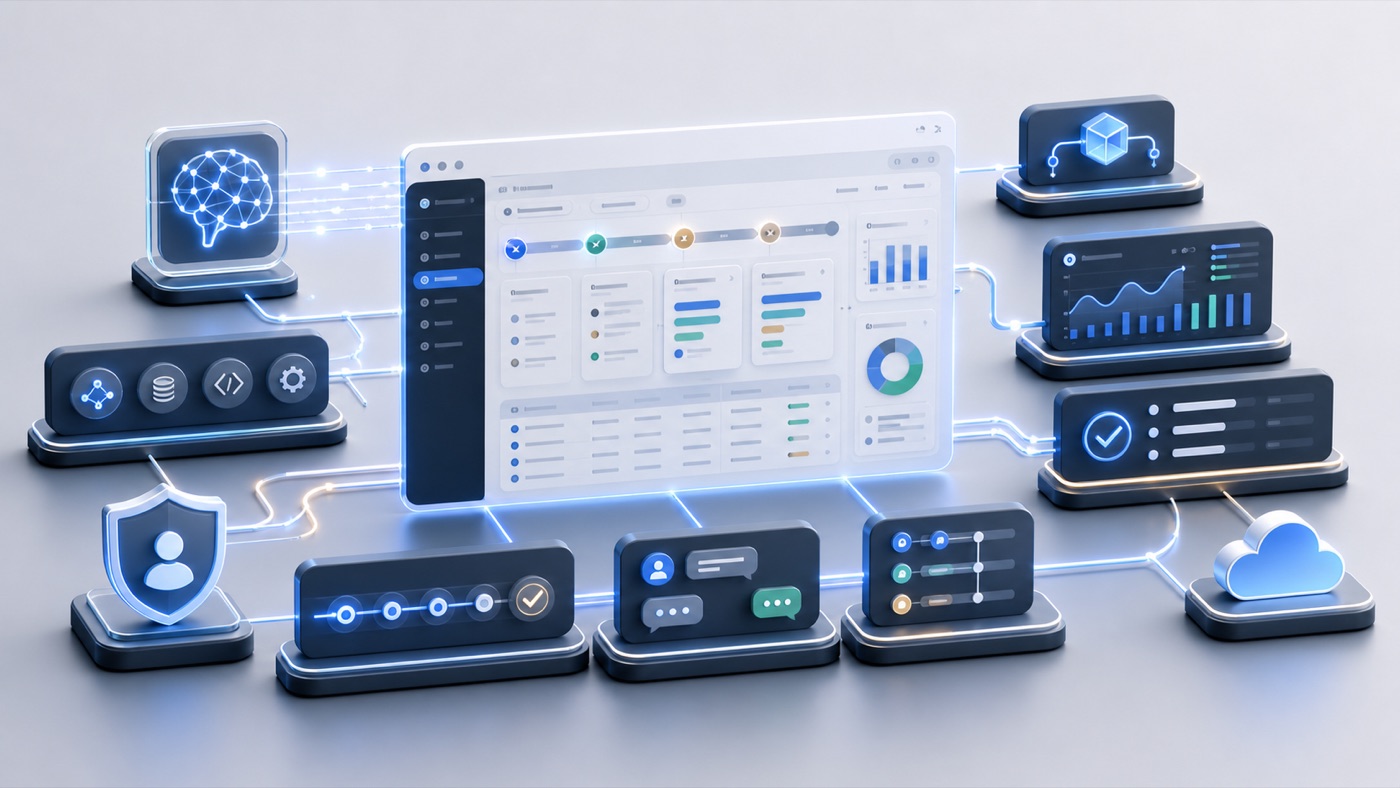
The future of enterprise software is not just asking AI to generate screens. That is only the beginning. The real shift is combining AI, runtime architecture, collaboration, authentication, BFF, auditability, an LLM proxy, and publishing into a platform that can create custom enterprise software with SaaS-like speed.
That is the thesis:
In 2026, the advantage will not come from using AI to write code. It will come from using AI to create complete, operational, customizable enterprise systems at the speed software teams used to expect only from SaaS.
Companies do not live in generic workflows
Every SaaS starts with an elegant promise:
“We already solved this problem for you.”
And often, it has.
Until the company grows, changes its process, adds an exception, needs a different approval flow, connects an external channel, creates a pricing rule, changes operations, opens another branch, serves another country, or simply discovers that the real workflow does not fit inside the product.
That is when invisible workarounds appear:
- parallel spreadsheets;
- WhatsApp groups;
- decisions buried in email;
- tasks outside the system;
- users copying data from one screen to another;
- fragile integrations;
- manual reports;
- automations nobody fully understands.
The software still exists. But the real work escapes it.
That is the gap ERP and SaaS often handle poorly. ERP tries to solve it with more configuration and consulting. SaaS tries to solve it with more integrations and enterprise plans.
AI opens a third possibility: custom enterprise software, created and evolved with much less friction.
Generating code is not enough
There is a large difference between generating code and generating a system.
An enterprise system needs far more than visual components:
- authentication;
- permissions;
- users and groups;
- a fast frontend;
- a reliable backend;
- auditability;
- monitoring;
- master data;
- collaboration;
- tasks;
- automations;
- controlled AI costs;
- publishing;
- versioning;
- the ability to leave without lock-in.
If AI only generates the screen, the customer still has to assemble everything else.
That is why the most important question in 2026 will not be “which tool generates better code?”
The better question is:
which platform can turn business intent into operational enterprise software?
The new architecture: creation, runtime, and collaboration
To build modern enterprise systems with AI, we need to stop thinking about a single tool and start thinking in three dimensions.
1. Creation
Creation is where business intent becomes software.
It is the space of the Studio, specifications, page comments, AI-assisted editing, version control, pull requests, and publishing.
The point is not to replace every human with a magic box. The point is to dramatically reduce repetitive manual programming and let the company evolve the application through intent, review, and governance.
In a modern model, the Studio should not live in a separate universe. It can be loaded inside the customer domain, allowing comments and changes in the real context of the application.
For small companies, this must stay simple and direct.
For large companies, it must support approvals, pull requests, environments, and permissions.
The same product should be able to respect both worlds.
2. Runtime
Runtime is where generated software becomes a running application.
This is the part many code-generation tools ignore.
The runtime must answer:
- how does the frontend load?
- how do routes work?
- how does the backend receive commands?
- how does the screen communicate with the server?
- how does the application record audit events?
- how do we observe failures?
- how do we publish locally or through a CDN?
- how do we change the master frontend or master backend?
In Collab.codes, this dimension appears through the combination of Collab Aura, Collab Forge, a common runtime, and a master config.
The frontend is not just a collection of pages. It is a SPA/PWA-ready runtime built with Lit 3, route-level loading, intelligent client-side caching, and BFF communication.
The backend is not just a set of endpoints. It is a master backend with BFF execution, auditability, monitoring, MDM, local Postgres, and remote DynamoDB as a path toward performance and hot backup.
3. Collaboration
The third pillar is collaboration.
Enterprise software is not used by isolated users inside perfect screens. It is used by teams.
Teams talk. Ask for help. Delegate. Create tasks. Call support. Need context. Resolve exceptions.
If all of that leaves the application and moves to WhatsApp, email, Slack, or spreadsheets, the system loses part of its value.
That is why Collab Messages matters in the Collab.codes vision.
It is not just chat. It combines messages, tasks, orchestration, agents, mini apps, and external channel integration through OpenClaw.
The idea is simple: the collaborator should be able to resolve work inside the application, without escaping to another channel.
Why BFF matters more than it seems
BFF means Backend for Frontend.
But that definition is too small.
BFF is not only a technical pattern. It is a way to bring the screen closer to business intent.
In many systems, the frontend calls several generic APIs, merges responses, transforms data, and tries to assemble an experience. That creates complexity in the browser and spreads product logic across the interface.
With BFF, the screen can ask for something closer to what it actually needs:
load the petshop home.
update this product and record the audit trail.
show the right screen to this user.
The backend starts to understand the experience better. The frontend stops stitching so many loose pieces together.
That reduces unnecessary traffic, improves perceived performance, and makes the system easier to evolve.
In 2026, with AI creating and changing software, this clarity of contract becomes even more important. AI works better when the architecture carries explicit intent.
The application needs a living aside
One detail can change the entire experience: the aside.
In an enterprise SPA, the aside does not need to be only navigation.
It can be where parallel work lives:
- messages;
- tasks;
- workflows;
- agents;
- mini apps;
- useful links;
- support;
- human intervention.
Imagine a petshop system.
The operator is editing products. A question appears about a breed, a medication, shipping, or a customer complaint. Instead of opening another system, they use a mini app. Instead of sending a WhatsApp message to the manager, they create a task in the context of the screen. Instead of asking someone to “take a look later”, they call an agent or workflow.
That changes the nature of the application.
It stops being a collection of screens and becomes a work environment.
AI without control becomes cost and risk
Another under-discussed point: AI costs money, changes fast, and requires governance.
One month, the best model for a task is one provider. The next month, it might be another. One model may be better for code, another for analysis, another for writing, another for cost.
Companies should not have to track all of that manually.
This is where an LLM proxy makes sense.
Collab LLM centralizes providers, aliases, billing, rate limits, cache, logs, evaluation, and cost-aware routing. An agent can request an alias such as code, and the platform decides which model makes sense for that task at that moment.
This does not need to become lock-in.
If the customer wants to leave, they can configure their own OpenAI-compatible endpoint and operate independently. But for many customers, the value is precisely not having to manage that complexity.
No lock-in does not mean no platform
There is a false opposition in the market:
either you use a powerful platform, or you keep your freedom.
That opposition should not exist.
A good platform should deliver enough value for the customer to want to stay, not trap the customer because leaving is impossible.
In the Collab.codes model, the thesis is:
- the code can live in the customer’s GitHub or GitLab;
- the customer can use their own providers;
- the customer can leave for their own auth, LLM, and hosting;
- the customer can have access to the Ubuntu server;
- Collab.codes centralizes costs because that is useful, not because it is the only way out.
That changes the commercial conversation.
The customer does not stay because they are trapped. They stay because the platform reduces work, operational cost, and complexity.
What changes for ERP and SaaS
Traditional ERP will continue to exist.
Traditional SaaS will continue to exist.
But a new category is becoming clearer: enterprise software generated and evolved with AI, with native runtime and collaboration.
This category combines the best of three worlds:
- the customization of a bespoke project;
- the speed of SaaS;
- the operational structure of a platform.
That is what makes 2026 different.
The market is already moving in this direction. Recent discussions about AI-agent SaaS, modular ERP, generative UI, and intent-driven systems all point to the same conclusion: companies want software that is more adaptable, more automated, and closer to the real flow of work.
But the opportunity is not only to add AI on top of old systems.
The opportunity is to redesign how enterprise systems are created.
The practical manifesto
If we had to summarize it in a few lines:
Modern enterprise software should not start from an empty screen.
It should not start from a heavy ERP either.
And it should not end as generic SaaS surrounded by parallel spreadsheets.
It should start from business intent.
It should be created with AI.
It should run on a real runtime.
It should include frontend, backend, authentication, auditability, and monitoring.
It should bring messages, tasks, and automations into the workflow.
It should let the customer leave.
And it should be good enough that the customer prefers to stay.
That is the direction of Collab.codes.
Not just generating code.
Building modern enterprise systems with AI.