AI is making code cheaper to produce.
That is useful.
It is also easy to misunderstand.
The hard part of enterprise software was never only the act of typing code. Companies do not succeed because a screen exists. They succeed when that screen can execute a real workflow, respect permissions, connect to data, survive change, be monitored, be published, be audited, and evolve without becoming a liability.
That is why the next phase of AI software will not be defined by who generates the most code.
It will be defined by who can turn generated code into a working system.
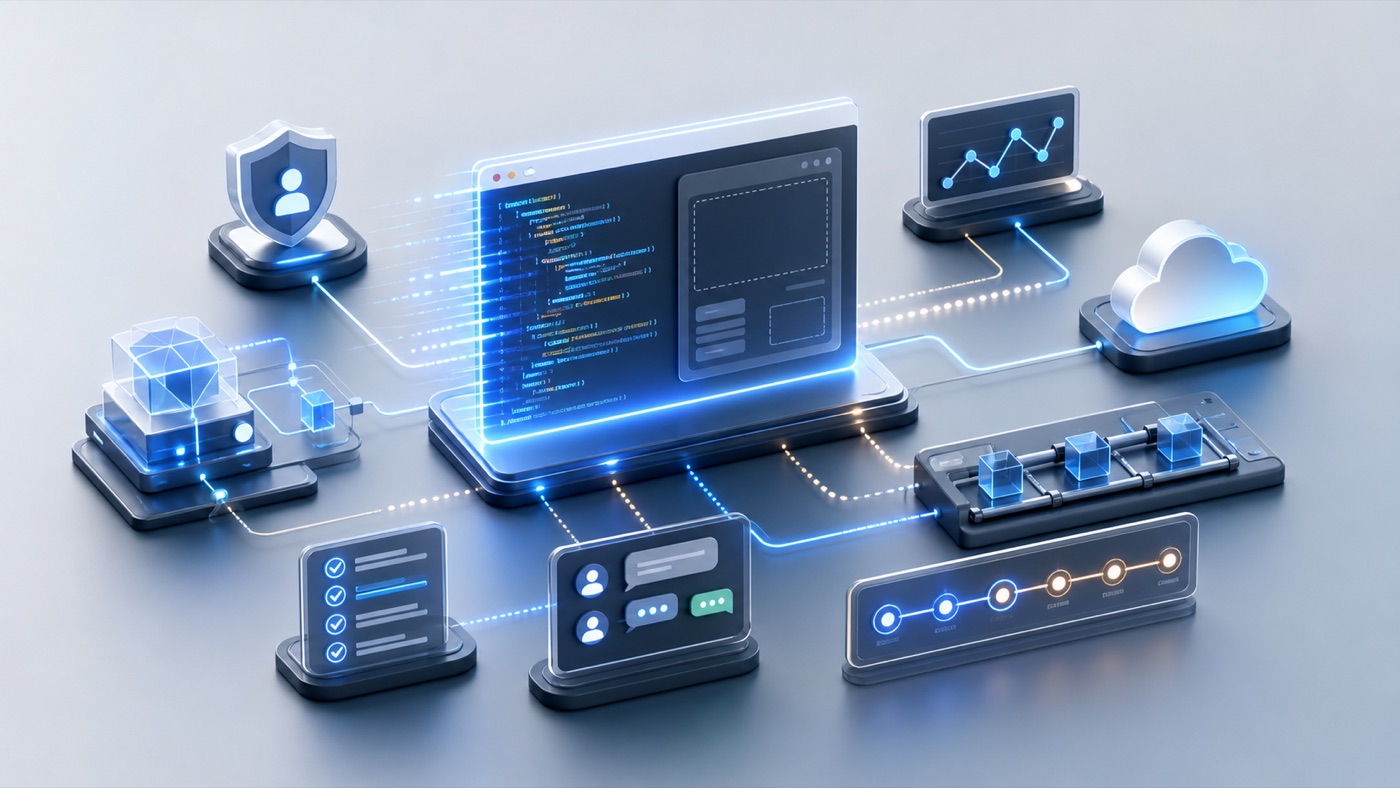
Code generation creates parts. Enterprise software needs a product that can run, be governed, and keep evolving.
The demo is not the product
Generated software demos can be impressive.
A prompt becomes a screen. A screen becomes a flow. A flow looks like an application.
For a few minutes, it feels like the hard work is over.
But enterprise reality arrives quickly.
Who can log in?
Who can see this record?
Which backend routine executes this action?
Where are errors logged?
How is the application deployed?
How does it connect to the database?
What happens when the user is offline?
How do we audit a change?
How do we control LLM cost?
How does a manager approve a workflow?
How does support understand what happened?
How does the next version ship?
Those questions are not cosmetic.
They are the difference between generated code and usable business software.
Fast generation can create fast debt
Speed is powerful when the system around it is ready.
Speed is dangerous when every generated screen invents its own architecture.
Without a runtime foundation, AI-generated software can fragment quickly:
- every screen calls APIs differently;
- permissions move into random frontend logic;
- error handling becomes inconsistent;
- backend routines are missing or duplicated;
- deployment is treated as an afterthought;
- observability has no product vocabulary;
- collaboration happens outside the application;
- LLM usage becomes hard to track;
- business intent disappears into code.
That is not acceleration.
That is operational debt with a better user interface.
The point is not that code generation is bad.
The point is that code generation needs somewhere disciplined to land.
Enterprise apps need runtime, not only files
A generated file is not an application.
An application needs an environment where it can run.
For business software, that environment includes more than hosting. It includes the practical machinery that turns screens into operations:
- frontend routing and loading behavior;
- backend routines shaped around product intent;
- authentication and permissions;
- BFF-oriented orchestration;
- persistence and data access;
- auditability;
- monitoring and logs;
- LLM routing and cost visibility;
- deployment and publishing paths;
- collaboration around the work itself.
This is why runtime matters.
Runtime is where the promise of generation becomes executable.
Without runtime, AI can create a lot of code that still leaves the customer responsible for building the actual product foundation.
The backend cannot be an afterthought
Many generated apps start from the interface.
That makes sense. Interfaces are visible. They help people react. They make the idea concrete.
But business software is not only an interface.
A product editor needs validation, permission, audit context, persistence, status transitions, and a controlled save routine. A support screen needs customer context, history, permissions, recommendations, and next actions. A dashboard needs a screen-shaped payload, not a pile of generic resources that the browser has to assemble alone.
This is where BFF matters.
Backend for Frontend is not just an API pattern. It is where the product intent of a screen becomes executable backend behavior.
If AI generates screens without a clear backend contract, the frontend becomes an orchestration layer by accident.
That works until it does not.
A serious system needs the frontend and backend to share a vocabulary of routines, permissions, events, and outcomes.
AI also needs operational context
AI agents are much more useful when the system around them is understandable.
An agent should not only see code.
It should understand:
- which screen is being changed;
- which routine powers the screen;
- which permissions apply;
- what data is in scope;
- what should be audited;
- which environment will receive the change;
- how the change will be reviewed;
- which model or provider should be used for the task;
- what cost and quality signals matter.
That context does not appear automatically because code was generated.
It comes from architecture.
It comes from conventions.
It comes from runtime services.
It comes from a product system designed for AI-assisted creation and maintenance.
Collaboration cannot live outside the product forever
There is another gap in code generation tools: they often ignore how work continues after the first version.
A customer sees a page and wants to suggest a change.
A manager wants approval before a workflow changes.
A developer or AI agent needs context.
Support needs to know why something happened.
A task needs to be tied to a screen, a record, and a responsible person.
If all of that happens in email, screenshots, spreadsheets, and chat tools outside the app, the software loses context.
The generated application becomes a place where data is stored, while the real work happens somewhere else.
That is why collaboration matters as part of the product architecture.
Messages, tasks, comments, mini apps, and agents should be connected to the application workflow, not floating beside it.
What Collab.codes is really trying to combine
Collab.codes is not trying to be just a code generator.
The deeper idea is to connect three dimensions:
- creation;
- runtime;
- collaboration.
Creation turns business intent into software.
Runtime makes the application executable, observable, governable, and publishable.
Collaboration keeps people, tasks, messages, mini apps, and AI agents connected to the work.
Each dimension matters.
Creation without runtime produces fragile demos.
Runtime without creation is too slow for the AI era.
Collaboration without application context becomes just another tool.
The value is in the combination.
The future is not more code
The market will generate code faster every year.
That is almost guaranteed.
But as generation becomes easier, the differentiator moves.
The winning systems will not be the ones that produce the most files. They will be the ones that preserve intent, provide a runtime foundation, connect frontend and backend behavior, manage AI usage, keep collaboration close to the workflow, and create a path from idea to production.
Code still matters.
But code is not the business outcome.
The outcome is a working application that can be used, governed, changed, monitored, and trusted.
That is why generating code is not enough.
The next generation of enterprise software needs to generate the system around the code too.