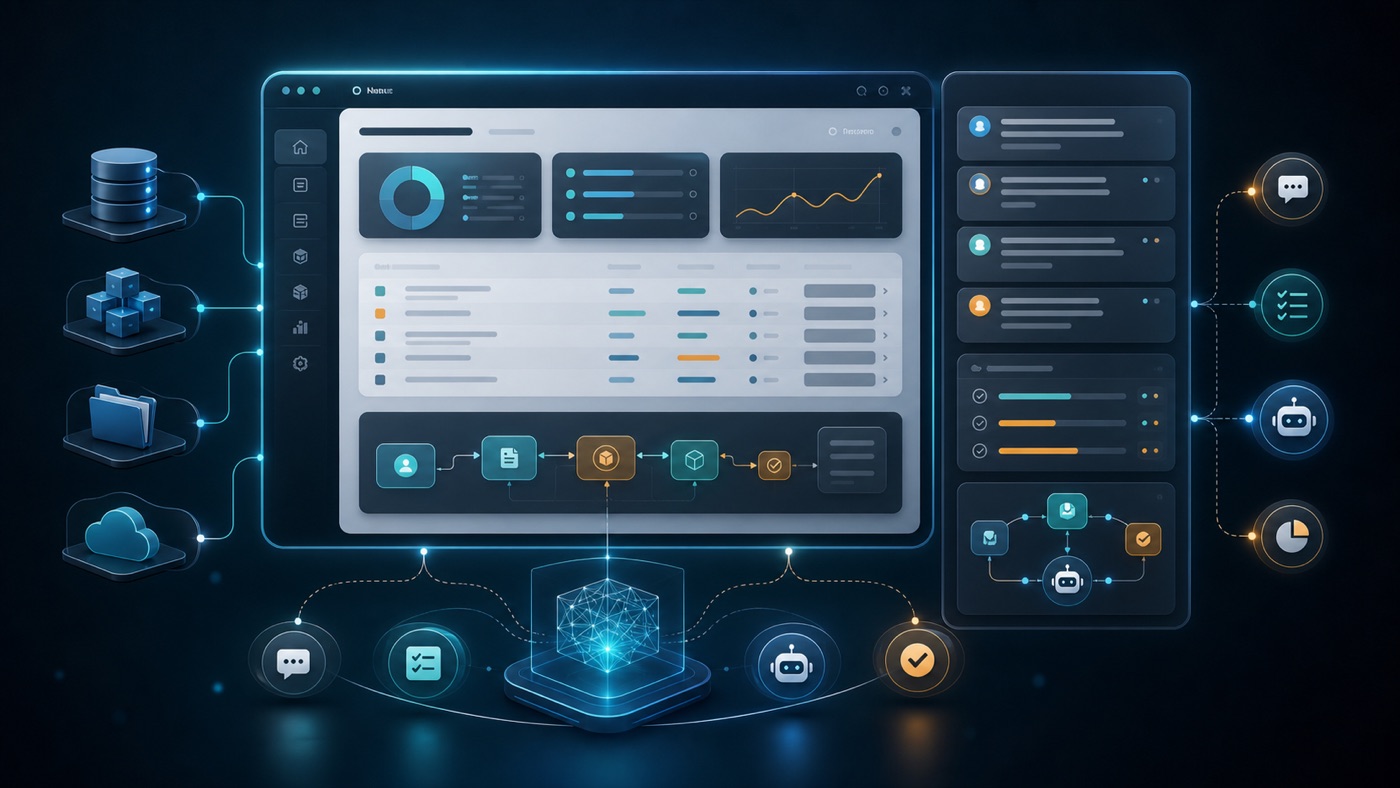
Most business applications are designed as if work happens only inside forms, tables, dashboards, and reports.
But that is not how companies operate.
Real work happens in the space between screens.
A manager asks a question. Someone sends a message. A task is created. A customer exception appears. A person needs approval. A support case needs context. An AI agent can help, but only if it understands where the work is happening.
When that work leaves the application, the system starts losing value.
The data may still be inside the app.
The work is not.
That is the problem modern business software needs to solve.
The next generation of enterprise applications will not separate software, chat, tasks, and AI agents. It will bring them into the same workflow.
The invisible cost of work leaving the app
Every company knows this pattern.
The system says one thing.
The team discusses it somewhere else.
A customer issue starts in the application, moves to WhatsApp, continues by email, becomes a task in another tool, and ends with someone updating the system manually.
Nothing looks broken from a software architecture diagram.
But the business process is fragmented.
This creates costs that are easy to ignore:
- decisions lose context;
- tasks become detached from the screen that created them;
- approvals happen outside the audit trail;
- support depends on memory and screenshots;
- people copy information between tools;
- AI agents receive less context than they need;
- the application becomes a database instead of a work environment.
That last point matters.
If the application is only where data is stored, people will do the real work somewhere else.
Chat alone is not enough
Chat is useful.
But chat by itself does not solve business workflow.
Slack did not eliminate task tools. WhatsApp did not eliminate CRMs. Email did not eliminate ERP. Every communication channel eventually becomes another place where work can hide.
The issue is not communication.
The issue is disconnected communication.
A message that is not tied to a screen, record, task, permission, workflow, or business event becomes another fragment.
That is why business apps need more than chat embedded in a sidebar.
They need collaboration that understands the application context.
The message should know what product, order, customer, ticket, invoice, or workflow it belongs to.
The task should know who can act.
The agent should know what it is allowed to do.
The app should know what happened.
Tasks need context, not just assignment
A task without context is a reminder.
A task with context is operational leverage.
There is a big difference between:
Review this product later.
and:
Review this product because the stock status changed, the audit trail recorded the update, and the manager needs approval before the catalog is published.
The second task is not just a note. It carries business meaning.
That meaning should not live in someone’s head or in a message thread that nobody will find later.
It should live inside the application workflow.
This is where business apps can become much more powerful. A task can be created from a screen, tied to a record, governed by permissions, visible to the right people, and resolved without forcing the user to leave the app.
That changes the quality of work.
AI agents need workflow, not just prompts
AI agents are becoming easier to create.
That is good.
But an agent without workflow context is just another assistant waiting for instructions.
In business software, the agent needs to understand:
- which screen the user is on;
- which record is in scope;
- what permissions apply;
- what action is being requested;
- which routine should execute;
- whether a human must approve;
- what should be logged;
- what happens if the user is offline.
This is why agents should not live only as external chatbots.
They need to be connected to the application workflow.
Sometimes the agent can execute directly. Sometimes it should prepare a task. Sometimes it should call a human. Sometimes it should use an external automation layer. Sometimes it should stop because the user does not have permission.
That is not a prompt problem.
That is a product architecture problem.
The application should become a work environment
A modern business app should not be just a place where users go to update data.
It should be a place where work happens.
That means the app needs room for:
- conversations;
- tasks;
- workflow steps;
- AI agents;
- approvals;
- mini apps;
- useful links;
- support;
- human intervention.
This does not mean every screen needs to become crowded.
It means the application should have a collaboration layer that can appear when needed, stay connected to context, and let the user keep working without jumping across tools.
In a SPA, this can happen naturally through an aside or collaboration rail. The main screen remains focused. The surrounding workflow stays close.
That is the product idea behind Collab Messages.
It is not only messaging.
It is a way to keep collaboration, tasks, mini apps, and agents inside the same operational environment as the business application.
Mini apps are underrated
Not every business need deserves a full product module.
Sometimes the user needs a small tool:
- check shipping;
- look up a rule;
- compare products;
- inspect a customer note;
- calculate a price;
- consult a reference;
- trigger a small workflow.
If every small need becomes a full module, the product gets heavy.
If every small need lives outside the application, the workflow fragments.
Mini apps solve the middle ground.
They are focused, contextual, and useful. They can live inside the collaboration layer without forcing the main product to absorb every operational edge case.
For business software, this is a powerful pattern.
It lets the system grow around real work without turning every task into permanent navigation.
Why this matters for Collab.codes
Collab.codes is not only about generating screens.
The larger idea is to create business software that can be built, operated, customized, and evolved with AI.
That requires three dimensions:
- creation;
- runtime;
- collaboration.
Creation turns business intent into software.
Runtime makes the application executable, observable, and governable.
Collaboration keeps people, tasks, messages, and agents connected to the work itself.
If any of those dimensions is missing, the product becomes incomplete.
Generated screens without runtime are fragile.
Runtime without collaboration is operationally lonely.
Collaboration without application context becomes another chat tool.
The value is in the combination.
The future is not another tab
The future of business software should not be one more tab.
Not one more chat window.
Not one more task board.
Not one more automation tool disconnected from the system where the work started.
The future is a business application where the screen, the conversation, the task, the agent, and the audit trail share context.
That is how software becomes more than a system of record.
It becomes a system of work.
And in 2026, that distinction matters.
Companies do not need more places to talk about work.
They need software where the work can actually move.